
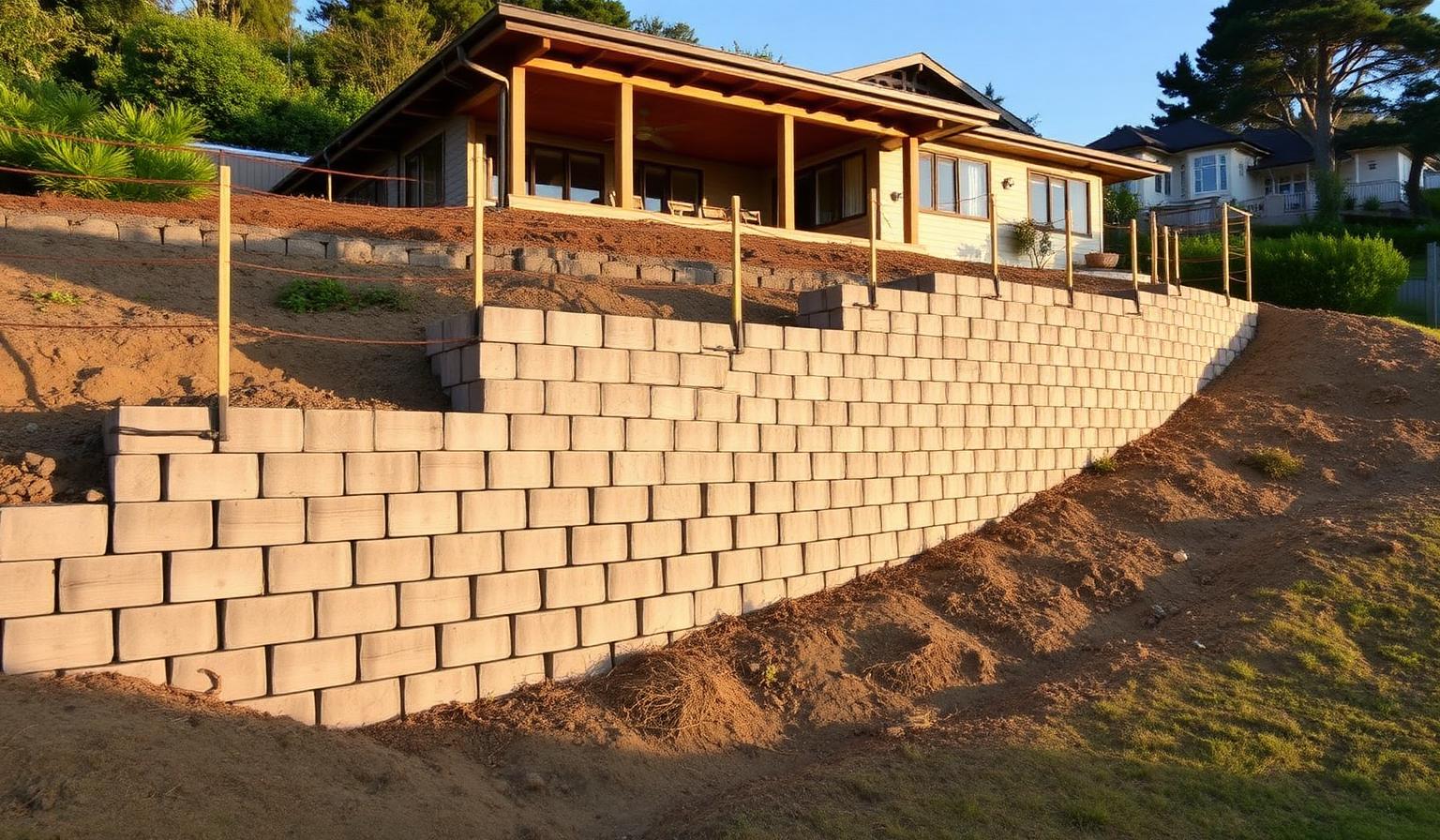
Retaining Walls in Tauranga: Types, Costs & What You Need to Know
Planning a retaining wall in Tauranga? Here's an honest guide to wall types, NZ pricing, council consent rules, and why drainage is non-negotiable.
Tauranga is a hilly city. From Bethlehem to Pyes Pa, from Welcome Bay to the Waikareao Estuary surrounds — a large proportion of residential sections in the Bay of Plenty have a slope that needs managing. Retaining walls are how it gets managed, and understanding what they cost, what type suits your site, and what the council requires is worth knowing before you start.
— Why Retaining Walls Fail
Before getting to types and costs, the most important thing to understand about retaining walls is why they fail. The most common cause is poor drainage behind the wall.
When water accumulates behind a retaining wall and has nowhere to go, it creates hydraulic pressure against the structure. Over time — or during a heavy rainfall event — this pressure causes the wall to lean, crack, or collapse outright.
A retaining wall without integrated drainage is not a finished retaining wall. It is a retaining wall waiting to fail. Every Peard retaining wall is built with drainage as standard — not as an add-on.
— Types of Retaining Wall in NZ
Timber (treated pine or hardwood): The most affordable option. Costs typically range from $300 to $450 per metre. Works well for smaller walls, garden beds, and property boundary walls. Expected lifespan 15 to 25 years with proper drainage and treatment. Regular inspection recommended as timber degrades over time, particularly in wet or shaded conditions.
Concrete block (keystone or similar): Interlocking concrete block systems. Costs typically $400 to $700 per metre. More durable than timber and require less maintenance. Suit both residential and commercial applications. Can be stepped or terraced for larger height differences.
Boulder / rock wall: Natural stone or engineered rock walls. Higher cost but extremely long-lasting and well-suited to lifestyle and rural properties. Aesthetic advantage — often preferred where the wall is a feature of the landscape.
Concrete block with engineering: For walls over 1.5 metres or walls supporting significant load (driveways, structures), a fully engineered concrete solution may be required. These are priced as full structural projects rather than per-metre rates.
— The 1.5 Metre Rule — Council Consent
In New Zealand, retaining walls over 1.5 metres in height generally require a building consent from the local council. In Tauranga, this means Tauranga City Council or Western Bay of Plenty District Council depending on the location.
The consent process requires a building consent application (fees vary but typically $500 to $1,000 depending on council), a structural engineer's design and specification report (typically $1,000 to $3,000 depending on complexity), and inspection at key stages of construction.
If your retaining wall is under 1.5 metres and is not in a position where it could affect an adjacent property, a consent is generally not required. However, this depends on proximity to boundaries, surcharge loads, and ground conditions — it is worth confirming with the council or a professional before assuming.
Peard Excavation can advise on consent requirements for your specific site and coordinate the engineering process as part of the build.
— Typical Retaining Wall Costs in Tauranga
As a guide, retaining wall costs in NZ typically range from $300 to $700 per metre depending on material, height, site access, and drainage requirements. This is materials and labour combined.
Additional costs to factor in: excavation to create the space for the wall and foundation ($500 to $3,000 depending on the cut required), drainage installation behind the wall (not optional, and included as standard in Peard's retaining work), engineer's report for walls over 1.5m ($1,000 to $3,000), and council consent fee ($500 to $1,000).
The per-metre rate does not tell the whole story. A 10-metre wall sounds straightforward but the total cost depends heavily on height, drainage, whether consent is required, and how accessible the site is for machinery.
— Getting the Scope Right
The best retaining walls are specified before the earthworks start — not as an afterthought when the site has been cut and the slope is exposed. If you are planning a new build or a site development in Tauranga, get the retaining discussed and included in the earthworks scope from the beginning.
Peard Excavation handles retaining walls and the associated excavation as one package. The drainage goes in behind the wall as part of the work, not as a separate contractor visit. One team, one invoice, no handover delays.