
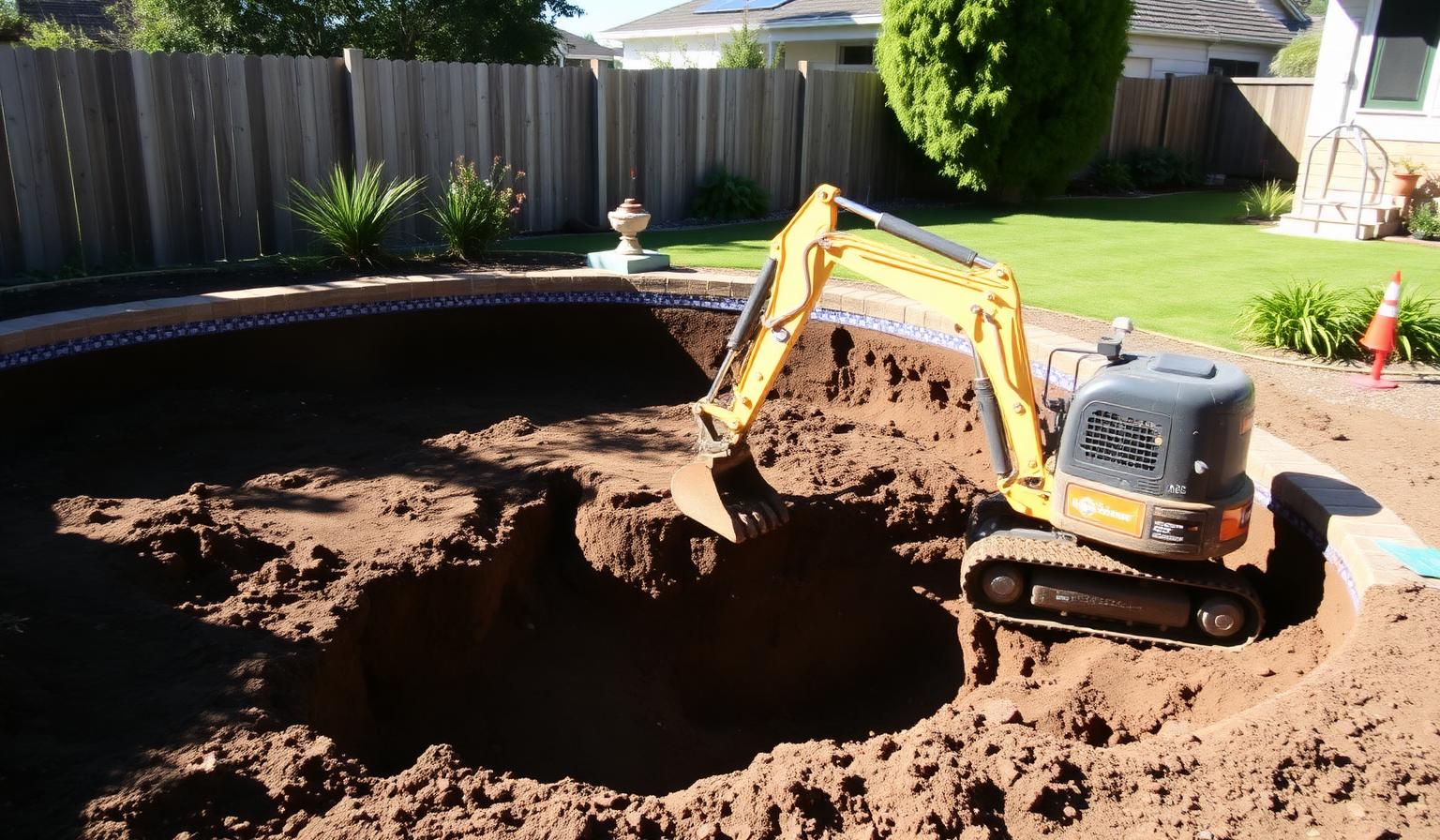
Pool Excavation Tauranga: What to Expect Before Your Pool Goes In
Planning a pool in Tauranga? Here's what pool excavation actually involves, what it costs, how long it takes, and what makes a tight access dig possible.
A swimming pool is one of the more involved backyard projects a Tauranga homeowner can take on — and the excavation phase is where a lot of the complexity sits. This article covers what pool excavation actually involves, how the pricing works, and what the key questions are before you book a digger.
— How Pool Excavation Works
Pool excavation is a precision dig. Unlike bulk site work where the tolerance is relatively forgiving, pool excavation requires the hole to match the pool design accurately — particularly for fibreglass pools where the shape is pre-formed and cannot be adjusted on site.
Mark out: The pool builder marks the perimeter of the pool on the ground. This is the reference for the excavation.
Excavation: The hole is dug to the design depth and footprint. For standard residential pools in the Bay of Plenty, this is typically 1.5 to 2 metres deep depending on the pool specification. A tiltrotator-equipped excavator can achieve complex freeform shapes that straight bucket machines cannot.
Spoil removal: All excavated material is carted off site. This is a significant volume of soil, particularly for larger pools. Disposal cost depends on the volume and what the material is.
Base preparation: The base of the hole is trimmed to the correct level and compacted or sand-bedded as specified by the pool installer.
— What Does Pool Excavation Cost in Tauranga?
Pool excavation in NZ typically ranges from $5,000 to $15,000. The main variables are pool size and depth, access, spoil type, and spoil volume.
Access is often the biggest variable on residential sites. If the pool is going in the back garden and the only access is through a side gate, the machine size is constrained. A 1.8 tonne machine can fit through most standard residential side gates. Larger machines are faster but cannot access every site.
Spoil type: Clay is heavier and costs more to cart and dispose of than sandy fill. Hard ground or rock significantly increases cost and time.
Spoil volume is calculated from the pool dimensions. For a standard 8 x 4 metre pool at 1.8 metres average depth, the excavated volume is approximately 57 cubic metres. At typical disposal rates, this represents a meaningful carting cost that should be included in the quote.
— The Tight Access Problem
A significant proportion of Tauranga residential sections have limited side access to the rear garden. The question of whether a digger can get through is one of the first things to confirm.
Standard residential side gates are often 900mm to 1200mm wide. A 1.8 tonne mini excavator in working configuration is typically 1.1 to 1.2 metres wide in blade configuration and can access most standard gate openings. Where access is tighter still, temporary fence removal or manual excavation for part of the work may be required.
At Peard, we do a site assessment before quoting any pool excavation. If the access is a problem, we tell you upfront and we tell you what the options are — not after the machine has arrived on the day.
— What Is a Tiltrotator and Why Does It Matter for Pools?
A tiltrotator is an attachment that sits between the excavator arm and the bucket, allowing the bucket to tilt and rotate 360 degrees independently of the machine. This gives the operator precision control that a standard fixed-bucket excavator cannot achieve.
For freeform pool shapes — curves, irregular edges, varying widths — the tiltrotator makes the difference between a hole that closely matches the pool design and one that requires hand-trimming and rework. It is particularly useful in tight access situations where the machine cannot reposition freely.
Peard runs a tiltrotator-equipped excavator as part of the fleet. For complex pool designs in tight residential sites in Tauranga, it is the right tool.
— How Long Does Pool Excavation Take?
For a standard residential pool with reasonable access, the excavation typically takes one to two days. Complex shapes, difficult ground, or tight access can extend this. Spoil removal runs alongside the dig and may add time depending on truck scheduling.
The pool installer typically takes over the site once excavation is complete and the base is prepared to their specification. Communication between the excavation contractor and the pool builder matters — any discrepancy in the base preparation spec needs to be resolved before the machine leaves site.
— Questions to Ask Before Booking Pool Excavation
What is the access situation and is a site visit included before quoting? Is spoil removal included in the price or quoted separately? Do you have a tiltrotator for complex or freeform pool shapes? What happens if we hit hard ground or rock? How do you coordinate base preparation with the pool installer?
Peard Excavation answers all of these upfront. Get in touch for a free quote and site assessment.