
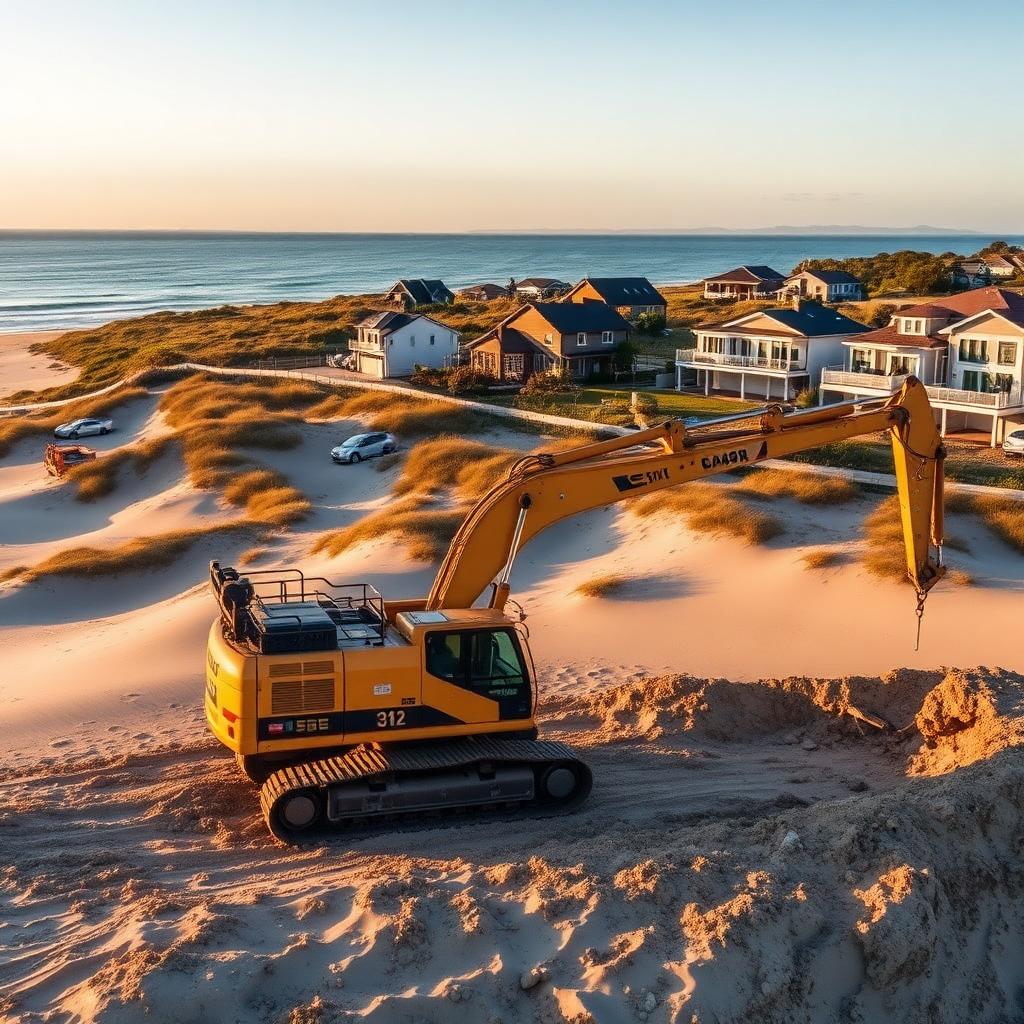
Building on Sand: What Excavation Really Involves at Mount Maunganui and Papamoa
Sandy sections at the Mount and Papamoa need different excavation: retaining, drainage and sequencing. A local contractor explains what to expect in 2026.
Sections at Mount Maunganui and Papamoa are not like sections in Bethlehem or Pyes Pa. The ground is sand. That single fact changes almost everything about how excavation is planned, sequenced and priced. If you are building at the beach, this is what you need to know before the first bucket goes in.
— Why the Mount and Papamoa Sit on Sand
The whole coastal strip from the base of Mauao out to Papamoa East is built on old dune systems. Under the topsoil you hit clean sand within a spade's depth, and it keeps going. That is great for drainage in one sense — water disappears through it — but it changes how the ground behaves under a digger and under a footing.
Water moves through sand at a completely different rate to clay. In a Bethlehem clay section, water sits and pushes. In a Papamoa sand section, water moves — sideways, downwards, and sometimes right through a poorly detailed retaining wall. Neither is a problem when the earthworks are designed for the ground you have. Both are a problem when the ground is treated as an afterthought.
— What Sand Does to an Excavation
Three things happen when you dig into sand that do not happen in clay:
Edges do not hold their shape. A clean vertical cut in clay can stand there for a week. The same cut in sand starts sloughing back within hours. That changes how deep you can cut before you need to bench, batter or shore, and it changes how tight you can work to a boundary.
Cuts want to collapse. A deep trench in sand is a live risk. Trenches for services or foundations need to be worked with either battered sides or proper shoring, and material stockpiled well back from the edge. This is straightforward for an operator who works sand every week and dangerous for anyone who does not.
Water moves through fast. Groundwater near the coast is closer to the surface than most people expect. Rain drains through sand and reaches whatever you have built underground quickly. Drainage is not optional on coastal sections — it is the whole design.
— Retaining on Sand: Drainage Matters More Here Than Anywhere
Retaining walls fail for one reason more than any other: water pressure behind the wall. On a clay section, water pressure is slow and constant. On a sandy section it can spike hard after heavy rain because sand feeds water to the back of the wall from further away than clay would.
Every wall we build at Peard has drainage integrated as standard — coil behind the wall, a metal-backfilled zone to let water reach the coil, membrane between the drainage zone and any soil above, and a proper outfall to daylight or the stormwater network. On a Mount or Papamoa job, we do not shortcut any of that. See the 2026 retaining wall cost guide for pricing detail and our retaining walls service for how walls and drainage come as one package.
— Working Between Neighbours on Tight Coastal Sections
Most beachside sections at the Mount and Papamoa are narrow. Houses on both sides, sometimes only a few metres apart, and access from the road only. That means everything you do to your ground affects the neighbour's ground — especially when the ground is sand.
The right approach is to sequence retaining as you go. Cut a section, put the retaining in, backfill and drain, then move along. Trying to open up an entire boundary at once on sand is how neighbouring driveways start cracking and how sheds start moving. Owner-operator commitment matters here — this is not the kind of sequencing you leave to whoever showed up that day.
Boundary care is the other half. Marked services located before dig, protective mats on shared access, and daily tidy so trucks in and out do not become the neighbour's problem. A good coastal job is invisible to the neighbours by the end of it.
— What It Costs vs a Standard Section
A sandy section is not automatically more expensive to dig than a clay one — the material comes out faster. What lifts the cost is what has to go back in: more retaining because vertical cuts do not hold, more drainage because water is the enemy, and more metal and membrane in the walls than you would use on a clay job.
Broad rule of thumb: budget for retaining and drainage costs at the upper end of the ranges in the retaining cost guide when you are pricing a Mount or Papamoa job. Excavation itself will sit at the standard $80 to $150 per cubic metre. The exact number comes from a free site visit — plans, boundary, access and neighbours all shift it.
— What This Actually Looks Like: A Recent Beachside Job
A recent residential job we completed in Mount Maunganui shows the pattern. Beachside section, houses on both sides, standard-width driveway access from the road. The plan called for block retaining walls to establish a build platform above natural ground level, and drainage to keep the walls dry through wet Bay winters.
The sequence: locate services, protect shared access, cut in sections and stand the block walls as we went, drainage coil and metal backfill zone behind every wall, membrane over the drainage zone before topsoil went back. Neighbouring ground stayed supported the whole way through. Job finished, site tidy, no cracked driveways next door, no callbacks.
That is what "designed for sand" actually looks like on the ground. It is not more complicated than a clay job — it is different, and it needs an operator who has done it before.
— Ready to Talk About Your Section?
If you are looking at a section at the Mount or Papamoa, or you already own one and the build is coming up, get us on site early. See our detailed excavation service and drainage service for the scope we cover in-house. A free site visit gets you a real number and a plan that works with the sand, not against it.
— FAQs
Can you build on sand in NZ?
Yes — sandy sections are built on across the Bay of Plenty every day. The difference is that the engineering, retaining and drainage need to be designed specifically for sand rather than borrowed from a clay-site build.
Do sandy sections cost more to excavate?
Usually. The digging itself can be faster, but the retaining and drainage that sandy ground demands add cost. A free site visit gives the real figure for your section.
Why do retaining walls need drainage?
Water building up behind a wall creates hydraulic pressure that pushes it over. Drainage relieves that pressure and is the single biggest reason a wall lasts or fails — even more so on sand where water moves fast.
Do I need consent for excavation on a sandy section?
The same rules apply as anywhere in Tauranga — permitted volumes, retaining thresholds and overlays all matter. Our earthworks consent guide covers it in detail.
What size digger works on tight coastal sections?
The right-sized machine for the access. Beachside sections are often tight between neighbours, so machine choice matters — too big wastes time getting in, too small takes twice as long once you're there.