Key Takeaways
Choosing a contractor requires balancing technical capability with reliability. These points cover the essential criteria for selecting a high-quality partner in the Bay of Plenty region.
- Prioritize contractors with modern, well-maintained fleets and specialized technology.
- Verify health and safety certifications to protect your project and site liability.
- Seek transparent pricing models that detail potential hidden costs before work starts.
- Evaluate past performance through references and site photos of similar projects.
- Ensure the contractor provides end-to-end management to minimize subcontractor delays.
Understanding bulk excavation requirements in the Bay of Plenty
Soil types and site terrain challenges
The geography of the Bay of Plenty presents unique obstacles for earthworks, ranging from volcanic ash layers to high-moisture coastal sand. Understanding how these soil types react to excavation is critical before you break ground on any site, as it directly impacts staging and machine selection. Most developers find that consulting an expert early helps determine whether the ground is stable enough for heavy loads.
Regulatory requirements and local consenting
Navigating the local council regulations is an unavoidable part of the process, particularly regarding earthworks and site disturbance. You must ensure your project aligns with regional guidelines to prevent stop-work notices or costly delays during the construction phase. Working with a bulk excavation company Tauranga that understands these local codes is often the difference between a smooth approval and a bureaucratic headache.
Environmental management and silt control
Protecting the environment is a non-negotiable aspect of modern earthmoving, requiring robust sediment control strategies to capture runoff during heavy rain. Properly installed systems keep local waterways clean and prevent soil erosion, ensuring your project remains fully compliant with environmental standards throughout the winter months. An effective erosion management plan includes these standard protective measures:
- Silt fences installed along property boundaries to capture sediment.
- Clearly marked washdown areas for equipment to prevent site contamination.
- Regular inspection logs to verify compliance with council documentation.
- Strategic stockpiling to avoid unnecessary soil disturbance near drainage。
Proactive management of these factors reduces long-term liability for landowners and developers alike.
Key credentials to look for in a local contractor
Industry certifications and health and safety compliance
Safety stands as the bedrock of any successful earthworks project, and verifying your contractor's credentials is the first step in risk mitigation. A legitimate provider will easily share their safety documentation, including staff training records and industry-standard certification for machinery operation. Prioritizing firms that maintain rigorous adherence to these protocols protects your site from both legal risks and preventable accidents.
Proven experience with large-scale earthmoving
Large-scale projects demand more than just heavy machinery; they require deep experience handling complex site logistics and mass earth movement. You want a team that understands how to move thousands of cubic metres while keeping the site accessible for other trades. Proven project expertise is mandatory when dealing with tight timelines to ensure that the bulk removal phase finishes on schedule.
Verification of insurance and liability coverage
Before hiring, you must confirm that the contractor holds comprehensive public liability insurance to cover potential site damage. It is a standard procedure to request a certificate of currency early in the negotiation process as it protects your investment. Without this proof, your property and adjacent assets are unnecessarily and dangerously exposed to financial loss.
Evaluating the equipment and fleet capacity
Importance of modern machinery for project efficiency
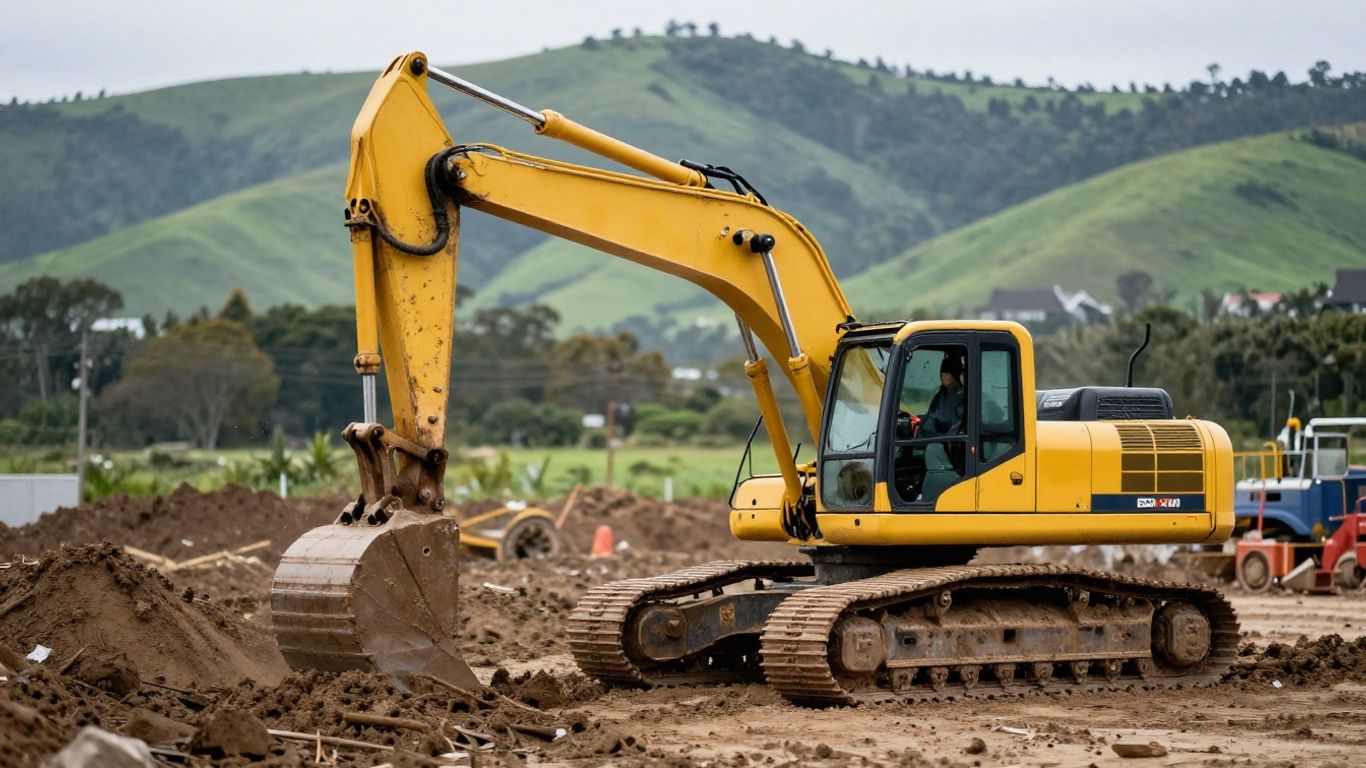
Modern machinery significantly influences the speed and accuracy of your site works, especially when working with high-precision GPS or laser-guided systems. Older gear often struggles on difficult terrain and lacks the efficiency required to keep projects on track. Peard Excavation utilizes a modern, well-maintained fleet equipped with 360-degree tiltrotators, which allows for greater maneuverability and precision, ultimately saving time and resources.
Matching equipment size to your specific site needs
Matching the right excavator to your specific lot size prevents unnecessary disturbance and lowers mobilization costs. Large machinery is excellent for vast rural tracts, but it is often inefficient or physically impossible to deploy on smaller residential sections. To choose the right approach, compare the capabilities of different equipment sizes:
| Equipment Type | Best Application | Benefit |
|---|---|---|
| Micro Excavator | Residential gardens | Low impact on landscaping |
| Medium Excavator | Standard house sites | Optimal balance of reach and speed |
| Large Excavator | Bulk earthworks | Efficient high-volume spoil removal |
Selecting the right equipment ensures you are not paying for capacity that your site simply does not require.
Availability and maintenance schedules to prevent downtime
Reliability depends on whether your contractor has a consistent maintenance schedule to minimize mid-project breakdowns. If a machine fails on-site, the resulting downtime can ripple through your entire construction schedule, causing massive delays to other contractors waiting to start. Look for companies that manage their own maintenance cycle in-house to ensure the fleet remains operational when your deadline is tight.
Planning and project management processes
Developing realistic timelines and milestone planning
Success in earthworks requires careful planning that accounts for weather, material disposal, and site conditions well in advance. Without a hard milestone schedule, projects frequently slip, causing cascading costs that impact your entire budget. Setting clear, achievable goals at the start creates a framework where both the owner and the operator can monitor progress effectively.
Clear communication protocols for site managers
Communication is the glue that holds a construction project together, particularly when multiple trades are overlapping on a busy site. Using a site preparation methodology that prioritizes daily check-ins prevents simple misunderstandings from turning into expensive rework. Having one point of contact who understands the full project scope ensures that instructions are followed precisely and without ambiguity.
Waste management and bulk material disposal strategies
Disposing of spoil material efficiently can save thousands in transport costs if managed correctly from the start. Rather than simply hauling soil away to the nearest tip, a skilled operator will look for ways to reuse fill on other parts of the site. This strategy reduces the total number of truck movements, minimizes your environmental footprint, and significantly cuts down on overall project spending.
Understanding pricing models and budget considerations
Comparing fixed-price contracts versus hourly rates
The choice between hourly and fixed pricing often depends on the level of predictability your site offers. Hourly rates are appropriate for smaller, variable tasks, but fixed-price contracts offer better security for major bulk earthmoving where the scope is clearly defined. Each model carries different risks for the homeowner, so discuss which option provides the best budget certainty for your specific job.
Identifying common hidden costs in earthworks
Hidden costs often arise from unforeseen ground conditions like rock, excessive moisture, or unexpected drainage requirements. These items should be detailed in your initial project assessment, as they often fall outside of standard site excavation quotes. If a contractor doesn't discuss these potential budget stressors during the planning phase, it is a sign that the final invoice might contain surprises.
Value engineering to save on bulk removal costs
Value engineering focuses on finding smart, efficient ways to achieve the desired site outcome while keeping the cost of removal or import as low as possible. By assessing the site grade and soil levels before the diggers arrive, Peard Excavation identifies opportunities to keep materials on site rather than paying for disposal. This approach directly contributes to a leaner, more budget-conscious project.
Assessing local reputation and past performance
Checking references for similar Tauranga-based projects
References provide the most honest insight into how a contractor truly operates under pressure. Do not hesitate to ask for testimonials from other clients who have managed similar residential or commercial builds in the Bay of Plenty. Speaking with a previous client about their experience helps you gauge how well the contractor handles problems when they arise on-site.
Inspecting site photos from previous contract jobs
Visual evidence of past finish quality can tell you a great deal about a company's standards for precision and cleanliness. Well-executed earthworks should look tidy, with clearly defined boundaries and proper compaction surfaces that indicate a professional finish. If a gallery features only long-range shots without detail, it may be worth asking for more specific examples of their work.
Checking industry reputation and contractor longevity
Longevity in the Bay of Plenty earthmoving industry is a testament to consistency and reliability. A company that has operated successfully for several years has likely proven its ability to navigate changing market conditions and complex local requirements. Choosing a stable, established contractor gives you peace of mind that support will be there long after the final excavation is complete.
Conclusion
Choosing the right partner for your excavation needs is about finding a balance between technical expertise and clear, transparent communication. By focusing on contractors who value efficient fleet management, regulatory compliance, and realistic site planning, you ensure a solid start for your build. Take the time to vet your options carefully, and you will set the stage for a smooth, stress-free construction project in the Bay of Plenty.
Frequently Asked Questions
Why is hiring a local contractor an advantage?
A local company brings essential knowledge of the region's specific soil conditions and council requirements, which helps them avoid common pitfalls during site preparation.
Does weather impact the excavation timeline significantly?
Heavy rain can saturate the ground, making it difficult to operate machinery safely and potentially causing delays to stay compliant with silt control standards.
What does an owner-operated service offer me?
Working directly with an owner-operator means you get a consistent point of contact who is personally responsible for the quality and timing of your project.
How long does a site feasibility assessment take?
Feasibility assessments generally involve an on-site visit and a consultation period to review reports, often resulting in a written summary within a few days.
Is it normal to have hidden costs in earthworks?
Unforeseen ground issues can happen, but a professional contractor should discuss potential risks and clarify what might be excluded from the base quote beforehand.
How does modern GPS technology improve excavation?
Advanced laser or GPS-guided systems ensure that site cuts are accurate to very fine tolerances, which reduces the need for costly corrective work later.
Can my project use soil removed from another area?
Yes, re-using material found on-site is a standard practice in value engineering that lowers disposal transport costs and reduces the environmental footprint of your build.